
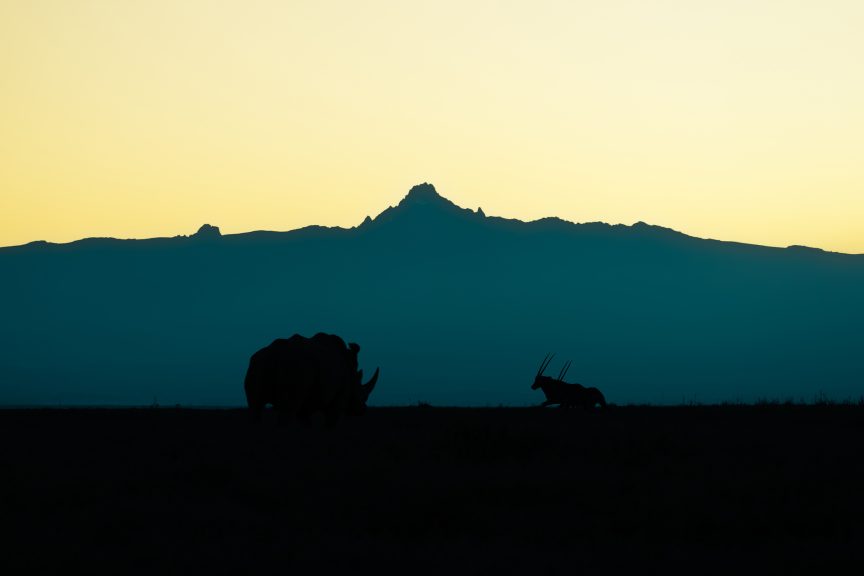
Want to make stronger photographs? Consider your layers of impact—or the power of three. Let me explain.
Few photographs are truly compelling to us because of just one thing. A person, a landscape, a beautiful bird. Beautiful on its own, perhaps, but once it becomes a photograph, we usually need more.
An interesting person in great light, with a great spark in their eyes? Now, that we can connect with. A dramatic mountain with an interesting foreground that leads us into the scene, all in soft warm light? Oh, hell yes! Two birds with blue feathers against an orange background and a moment of tension hanging in the air between them? Yes, please. More of that!
Now, this is just a theory, so if you prefer my ideas a little less half-baked, then I’ll make it up to you next time. I’ve been noodling on this a while, and I’m convinced there’s something to it: a strong photograph needs to work for three reasons, not one. So often I look at a photograph that isn’t working for me and the only reason I can come up with is this: there’s not enough. It’s one thing—just one—and try as I might, I can’t describe it in threes. Look at how I described the images above: a dramatic mountain (that’s one) with an interesting foreground that leads me into the scene (two) all in soft, warm light (three!). I don’t just mean it has a subject, a foreground, and light. It has three interesting elements.
Subject is almost never enough. The world is full of subjects that we might love, but in the photograph, don’t interest us. The picture has to make them interesting.
So we do that with things like:
- Great colour or colour combinations
- Textures we can almost feel
- A meaningful gesture
- Great catchlight in the eye
- A story, or some kind of action
- A juxtaposition
- Mood!
- Tension between elements
- Contrast
- Creative point of view
Rarely is it sharpness, so don’t even start with “but it’s a really sharp portrait!” That’s not enough. But a portrait of a subject in interesting light with a strong gesture? Sure! And then if it also has an interesting juxtaposition and it’s sharp in all the right places, well, that’s just layer upon layer of impact and we’re here for it.
When I look at one of my photographs—or an image I’ve been asked to give feedback on—I ask myself: are there layers of impact? Or am I being asked to find my entire interest in just one thing because that’s all there is?
For example, if it’s a picture of “just a bear” and I can’t find another layer or two of impact, that probably explains why I don’t feel like the image is a success. If I can find three strong elements or decisions, I usually feel like the image has enough to engage me, and perhaps others. A bear doing something interesting, photographed from an interesting angle? Now we’re building something!
I sometimes flip the question: “Is it just a leopard?” Look, I love leopards. And in the wild, there’s no such thing as “just a leopard.” But in a photograph? I’ve seen a million leopard photographs and my very sharp picture of a leopard isn’t going to cut mustard unless it has something more.
Here’s another way of approaching this same idea: ask yourself, “What’s the hook?” For someone who wasn’t there and has no emotional connection to the subject, what’s visual in the photograph that might make them care?
A hook can be any of the things I mentioned in bullet points above. It might be something else, but it’s something we care about, represented in a way we care about. No hook? You might not have any impact, either.
My hard drives are full of images that almost made it. But they didn’t. Just a boring picture of a beautiful thing. No hook, no impact. Only subject. It’s heartbreaking when you’ve worked so hard only to come up short, but that’s life and our work will be better when we’re unflinchingly honest about it. Look, sometimes the light doesn’t pop. Sometimes your subject doesn’t do what you hoped and there’s no action, no gesture. Or there is, but it just doesn’t translate. It’s not even sometimes; it’s most of the time. It’s the rule, not the exception (that’s what makes it unexceptional). It’s 99% of the time. An exceptional photograph happens in the 1%.
So what do you do in the yawning chasm of time when “nothing’s happening”? You watch. You wonder. A great subject might not be enough on which to place the burden of a killer image, but it should be plenty on which to rest your awe. All that time not making photographs when we’re out in the wild is not time wasted. It’s time breathing more deeply, letting our minds release the stress of our urban lives. It’s time spent finding our natural place in the world. Letting the sun fall on our faces or the wind beat against our ears. It’s time to be more fully alive, enjoying the pursuit. And it’s time to make sketch images and learn to make what works by making lots and lots of what doesn’t work.
We spend 99% of our time looking for the 1%. The 1% makes the photograph more alive, but it’s the 99% that does that for the photographer.
For the Love of the Photograph,
David
Comments
Great article David. I think we need to have this article next to us when we view photographs that we like and try to find out what exactly is that stands out and make the photograph appealing to us. Studying photography this way makes us more aware of what actually works. Thank you for sharing this. Looking forward to hearing updates on your new book as well.
Thank you, David! I really needed these words today.
My pleasure, Alex. Thank you for reading.
Great article as always and I especially like the final quote – very inspiring and thought provoking.
Thank you
Nicola
Thanks, Nicola. Always an honour to write for wonderful people.🙏
Intriguing as usual, David. Always look forward to Sunday mornings, biweekly. But I’m wondering. What is it about threes? I get it that one or even two “layers” don’t quite do it; three are better. I get that…I think. But why three? What about four, or five? Are they too busy? And what about minimalist photos? Do the “killer minimalists” also have three elements/layers. They certainly have a hook (for me anyway). It’s all a puzzling, but (as I said) intriguing, subject of discussion. Philography, perhaps? Or photosophy?
Hi Rich, great question! I think it comes down to rhythm. 2 isn’t a pattern or a rhythm, but three is. And it’s memorable. Like a story or even joke: set-up, conflict, resolution. Even in our garden at home, we’ll arrange 3 plants but 4 just doesn’t feel right. Too symmetrical? I don’t know.
I think this idea of three interesting attributes ties together nicely with the concept of storytelling. A standalone portrait doesn’t often tell a story, unless it’s the long story contained in Keith Richards’s face. But if there are multiple aspects of a photo that interact, it both generates more interest and can convey a story. And we humans do have a bit of a thing with threes.
Funny, Gord, I was just writing that in my reply to Rich, above. I think there’s something there for sure. The rule of threes is powerful to us and might be the reason we like the rule of thirds so much. Symmetry is nice, but it’s boring. 3 is never really symmetrical (ignore, for this example, the equilateral triangle…) 😉
Love this article! I shoot high school sports and often remind myself that just because an image is in focus, that in itself does not make it a good photo. A sharp image is awesome! But it’s other elements and layers that make the image interesting. Thank you for reminding me why those are so important!
I love this article too! Susan, I shoot a ton of high school sports as well. In the last year and have so many photos filling my hard drive that are just that photos, nothing special or exceptional although there are a few in that 1% category. But in the last year, I’ve really become intentional about looking for more of what David described here. It can be hard to get that shooting high school sports and making sure that every athlete is in a photograph, but even the intention of trying to make stronger photographs is making the whole job more fun for me. I’m slowing downs and seeing what I might be able to find. Now, if only I could get a sideline athlete to keep their arm on their hip long enough for me to frame some action. LOL!
Same, Christine! David (and his thought-provoking articles) have also made me slow down and try to intentionally create stronger images. It doesn’t always work out, but I do love the challenge!
Thank you, Susan. The challenge is the fun part, isn’t it? 😁
Happy to help, Susan. Focus can be important. It can make or break, but it’s not usually sufficient to hold our interest, peak our curiosity, or stir our emotions.
One finds what one looks for. My greatest satisfaction of taking up photography has been the increase in wonder and beauty in my life. Searching for these elements in my images has opened my eyes to the world even when I’m not behind the lens. The beauty is there even if it doesn’t translate. And it’s never a single medium. The sunset is even more moving with the warm breeze and sound of birds. The colorful wares of the street hawkers are more intense because of the cacophony of haggling. The decadence of the meal is a shadow in a photograph without the scent of spice and herbs. I wish I could capture those elements as well, but it’s enough for me to have experienced it, and even better if I was able to freeze that memory in light.
Indeed, David, the 99% spent looking has impacted me even more than the 1% I was able to capture. Now I see the beauty that is there, even if it doesn’t translate.
Ditto Don! I am too an getting so much more from observing more intently even if it doesn’t result in a photograph.
I like to think that the photograph amplifies an experience but isn’t usually the experience itself.
Beautifully expressed, Don. Thank you for that.